Monday, 3 November 2014

Storyboard

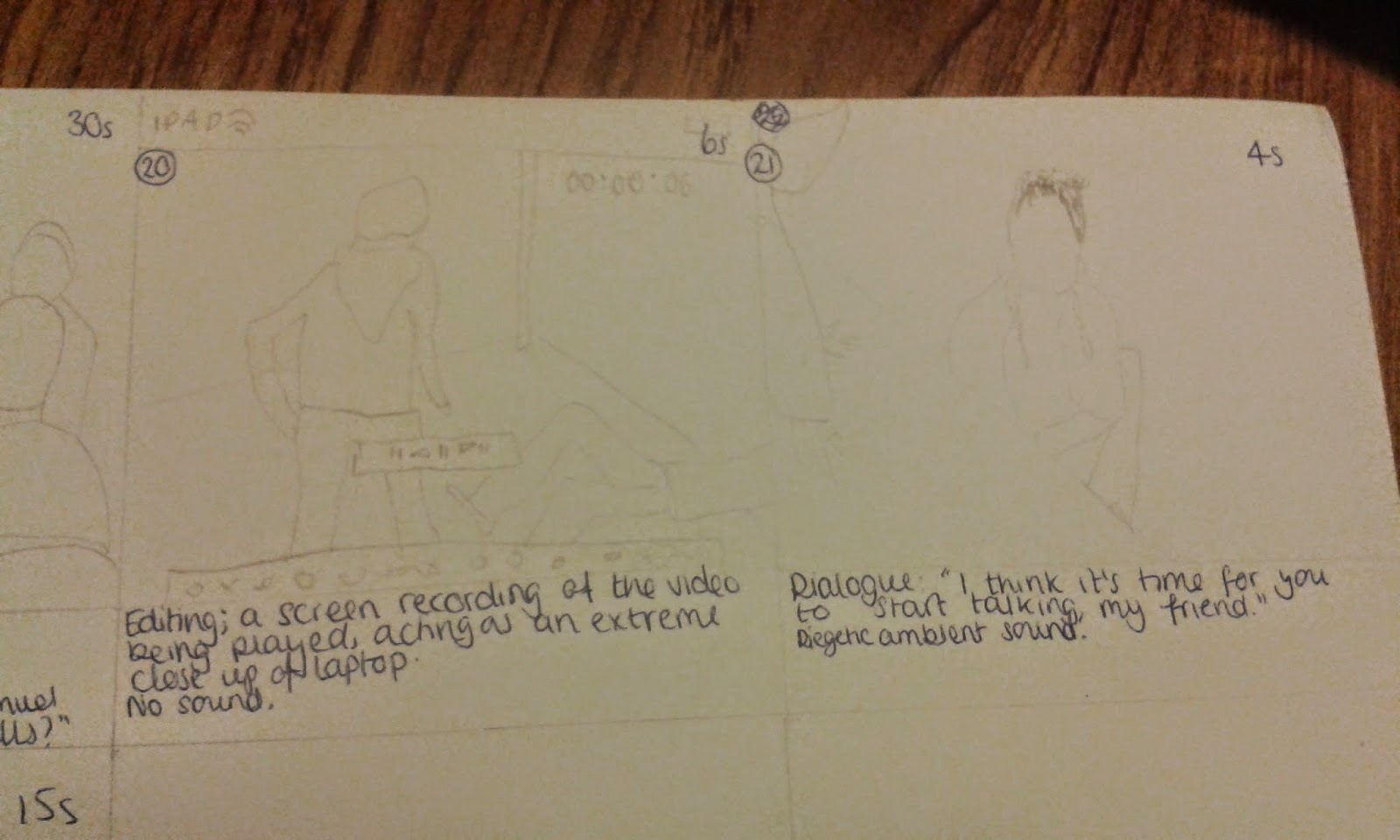
Storyboarding is an effective way of depicting your thoughts on the visuals of your film idea so that you can see it visually before going out on shoot. Therefore, we felt it necessary to draw out the basis of our film so that we could add in shots and experiment still, but also have a map to guide us. 


Script


1. EXT: FORE STREET – DAY  

An establishing shot of the town and cars moving along the road to set the scene of a country town.


2. INT: WAFFLES CAFÉ - DAY

Franklin and his best friend Sam go to a cafe to have a drink.


FRANKLIN’S MUM (V.O.)

I have got nothing against your friends, Franklin, I think Sam’s a great friend.


3. EXT: PRIORY POND - DAY

Medium shot/close up of Franklin and Sam holding film camera (use an old super 8 to look more visually interesting). Interchange with their view of the pond through the Super 8.


FRANKLIN’S MUM (V.O.)

I’m just not sure that making this film is going to be safe for your health.


4. INT: CAR - DAY


FRANKLIN’S MUM

You have to be careful, we just want you to spend more time with your family and focus on your revision.


FRANKLIN

I will, but I promised Sam I’d help him, and he’s my best friend. I can’t let him down, you know that, just trust us. You always told me I shouldn’t let people down.


     FRANKLIN’S MUM

Okay, okay. Stay safe! Don’t do anything illegal, if you start feeling bad I want you to come straight home, okay? Straight home.

5. EXT: OUTSIDE THE JAIL - EVENING

Franklin and Sam walk down to the asylum door. 


SAM

All the gear we need is in the rucksack I left by the door. Torches, crowbar, extra batteries, tripod, snacks. C’mon.


Sam runs towards the door, opens the rucksack and uses the crow bar to open the door. Franklin stops suddenly.


ANONYMOUS 

(in Franklin’s right ear) Franklin!


Franklin spins around, but Anon has disappeared from shot.

ANONYMOUS 

(in Franklin’s left ear) Franklin!


FRANKLIN

Get lost!


ANONYMOUS

Alright, calm it, kiddo. Hahaha. Nice evening?


The shot slowly zooms in to see Franklin’s face before zooming back out to both of them again, although the speech continues.


ANONYMOUS 

Not talking, ay? Well whatever, I’m coming with you.


He giggles insanely.

Franklin stares, frozen with fear.


FRANKLIN

No! You can’t. L-leave me alone!


ANONYMOUS

There really is no point in you trying to reason with me. You can’t escape. I’ve got you.


Franklin closes his eyes hard for a few seconds, then opens them and Anonymous is gone. He then backs up a few steps and starts to pull a prescription bottle and drinking water out of his back pack. He takes the pills and has a swig of his drink. He continues down the road.


SAM

Franklin, come inside before we’re seen, else we’ll get no footage at all…


Frank! You with me, buddy?


FRANKLIN

Yeah, sorry, coming.

They walk in.


6. INT: BODMIN JAIL – EVENING

The two boys turn on the camera once they are inside the door. Franklin is filming.  


SAM

Action!


The boys walk around, going through rooms, looking around. A medium close up from in front of Franklin shows him stop and start looking around and behind him. Anonymous appears in shot but Franklin cannot see him yet.


FRANKLIN

N-No… S-Shut up! I won’t let you in.


Franklin is filming Sam. An over-the-shoulder POV shot shows what Franklin can see through the viewfinder of the SLR. Creepy/scary stuff flashing on the lens near the room, but when Franklin looks up the scene looks normal but when he looks back at the viewfinder he sees Anonymous over near Sam.


*Lots of voices murmuring, can’t make out what they’re saying, but only Franklin can hear it*


ANONYMOUS

We’re coming for you, Franklin.


FRANKLIN

I took my meds, you shouldn’t be here. Fuck off out of here. 


He backs away and ends up falling backwards, into the arms of Anonymous who is now directly behind Franklin. A violent fight ensures between Franklin and Anonymous. The camera that gets knocked over is on its side capturing the violent fight.


*Murmering continues, growing in volume, still only Franklin can hear it*


ANONYMOUS 

Oh, Franky, you’re no fun.


Franklin crouches down, head in his hands. Before picking the crow bar and slowly rising up to Anonymous.


FRANKLIN

I said leave me alone.


The fight continues between Franklin and Anonymous, Franklin hits Anonymous over the head with the hammer. The voices disappear. Franklin looks down where Anonymous had collapsed to find that he has gone. He looks back up, confused and runs from the scene leaving the camera. He leaves the building and cinematography shows confusion and fear.


7. INT: POLICE STATION INTERVIEW ROOM – DAY

Sitting at the TABLE is FRANKLIN, across from two police OFFICERS. There is a CAMERA set up on a TRIPOD recording the interview.


OFFICER #2

Monday 1st September 2014, 13:25. Interview of Franklin Merchant.


OFFICER #1

You’re here today, Franklin, because we found your camera along with the body of Sam Peterson inside the old Asylum and we have reason to believe that you may know what caused Sam’s the death. On review of the footage, Exhibit A, it was clear that you were with him. I think there’s something you should see...


The tape plays on the screen in the police interview room. It shows Sam in the jail – no ghosts no horror. The camera falls to the floor and shows Franklin fighting himself/no one. Sam tries to restrain Franklin and finally Franklin kills Sam before looking around and running away.

Thursday, 30 October 2014

Lighting Research


The first part of this video from Film Riot tells us how to light a dark room, and how to make a light room seem dark. This is really helpful for the filming of my film because our location will have dark areas and light areas and we need to light it all in a way that makes it realistic, yet fitting with the horror-thriller genre. Furthermore, our film shoot will take place in the day time, meaning we can't get all of the darkness we will need for the film from the set and therefore darkening the film in post-production is a really helpful technique that we will need to use heavily when editing our footage. 

The information about light reflection is very helpful because I've learnt how this method softens the light and makes it look a lot more realistic than direct light. In this, I've learnt about the ways to light a scene so that the lighting on the subject can be controlled more specifically than have a light solid on both the subject and on the background. 


This video from the same company, Film Riot, goes into detail on the diffusion and breaking up of light. These techniques are relevant to my film because the use of a slitted board breaking up the light in the interview scene could make the scene look a lot more realistic and also build the tension in the scene, as I would like. Diffusion however could be used to highlight the emotions that the characters in the film are feeling in close ups. 


This final video, again from Film Riot, gives some really good techniques for lighting moving characters, which will be key for our horror film which features a lot of action. It tells you how to place your lights around a room in such a way that most of the lights do multiple jobs, meaning fewer lights need to be used and therefore they'll be easier to conceal and smaller production companies, like ours, with limited equipment, can light a scene as well as they want without having to have lots more equipment than they have. Another technique shown is boom lighting which may well serve as a very important feature of our film, being constantly on the move as well as minimal lighting being needed for the suspense within the narrative. Boom lighting is where the light is held above and in front of the subject, out of shot, much like a boom mic. This allows lighting to be used in smaller spaces where setting up larger light kits may not be possible. It's also effective in showing a more uncertain light source that complements the handheld camera work that we're going to use in our film. The final lighting technique in this video is using natural lighting, the sun, to light your shots outside with reflection. This may prove to be essential for our outdoor scenes where using the electric lighting kits isn't possible. 


Monday, 27 October 2014

Film Pitch/Treatment

Logline
A schizophrenic adolescent seeks to escape his own mind in an unlawful venture into an abandoned asylum.

Synopsis
The main character, Franklin, has schizophrenia, and against his parents will is going to make a film in an abandoned asylum with his best friend, Sam.  Now, Franklin is, throughout the film, being taunted by a boy, created by his own imagination, that only he can see. This is troublesome for Franklin, and even his medication won’t make him go away. Once inside the asylum, the two boys go to look around, filming as they go, when the anonymous boy returns to annoy franklin, who flips and starts to fight him, dropping the camera and eventually killing him. The final scene is a scene in a police station, where the police are interviewing Franklin upon the retrieval of the camera. When they look at the footage, it is clear that Franklin didn’t kill who he thought he did. 

Target Audience
The primary target audience for our film is 15-24 year olds that are of all genders and the secondary audience is 25-35 years olds, again of all genders. The audience beginning at 15 is due to the content of the film, which we believe would acquire a certificate rating of 15, yet will also be aimed at a younger audience, so this audience of young adults will fit the film very well. Furthermore, the secondary audience of adults is due to the film being a representation of mental illness and therefore the film will inform people of what people with this mental illness go through. 

Genre
The genre of our film is psychological thriller because the content of the film is about a boy with schizophrenia and the extremity of its symptoms, therefore our film fits this genre well. 

Actors
With very few Hollywood films actually casting kids to play kids, (instead they employ young adults, around 20 years old to play teenagers between 12 and 16) it's difficult for the viewer to really relate to the characters on screen, so I think it would be really important for the actors to be of the age that the characters are so that a) the narrative is more believable, and b) the viewers can relate to the character in more than just the narrative sense, i.e. in appearance and knowledge, etc. Therefore, looking at the few British tv shows with the teenage characters played by teenagers, I have found that: 

An actor that would play the character of Franklin well is Kane Tomlinson-Weaver, a young British actor that is used to acting with emotion from his role in Waterloo Road and would therefore be highly suited to a role such as this. 

An actress that would play Sam well is Finlay MacMillan, another young British actor that hasn't played many roles, but is noted for his role as a young cyclist and school student, also in Waterloo Road, and has credible acting ability.

Similar Films
Films similar to No Escape include Donnie Darko (2001) which is about a character who embarks on adventures in order to try and meaning from his hallucinations and Shutter Island (2010) featuring a character that shows symptoms of schizophrenia such as delusions of psychological manipulation.

Where it would be shown 
Being an independent production, our film would probably be shown at film festivals and small cinemas, such as Art House Cinemas and small local cinemas. 

Theory
In terms of Todorov's narrative theory, No Escape does follow the narrative structure of: equilibrium, disruption of equilibrium, recognising this disruption, trying to fix the disruption, and the restoration to a new equilibrium at the end. There is equilibrium at the beginning, with Franklin and Sam relaxing in a cafe and then naively going to make a film together, which is disrupted by Franklin’s hallucinations. Then, Franklin tries to get rid of his hallucinations – recognition and attempting to fix it, and then the new equilibrium is created when Franklin realises the result of his actions.


Propp’s character theory states that there are seven types of character that are commonly found in narratives: the villain, the donor, the helper, the princess, the false hero, the dispatcher, and the hero. No Escape involves a few of these character archetypes, but as it is only a short film there are very few characters. Franklin is the hero, as he is the victim of the story, generally, whereas Anonymous is the villain, and Sam is the helper, trying to help Franklin snap out of his hallucination, despite this ending in his death. 

Wednesday, 22 October 2014

Final Planning of the Film

 After deciding to redraft the synopsis and scrpt we decided that the best way to regain our thoughts was to, again, create a spider diagram of the main parts of the film, i.e. characters and locations.
 

Representation and Characters


This is an interesting video presented by Buzz Feed Yellow that explored the representation of women in horror films and contrasts this with a male character playing the role instead. This video gives the viewer an eye-opening view of the way women are represented as "sexual objects of desire" conforming to Mulvey's 1985 theory named the 'Male Gaze'. The use of the parallel editing to show the juxtaposition of the original film footage with the females next to their footage mocking this idea next to it shows how sexualised female characters are in order to appeal to the male audience of the film, despite sex being irrelevant to the narratives of horror films and unnecessary to be included. With the males being sexualised in the same way, it shows just how exaggerated the behaviour of the women is in an attempt to be attractive, and concludes how unnecessary its presence is. 

To further this point, in this article (page 10, figure 4.3.) the oversexualisation of men is theorised by MacKinnon when he says: “Men are increasingly and unapologetically objectified, both in terms of erotic spectacle and as targets of advertising for products beyond cars and beer, including many items once thought to be marketed for women alone,” (MacKinnon, 2003). This tells us how, in the same way that females are used to attract the male audience, males are used to attract women. 

It is clear that in the film and advertisement industries, the sexualisation of males and females is relied on in order to attract the opposite gender to certain products, and as I've touched on before in audience research, the sexuality of the audience not being necessary information to know when making a horror film because sexuality is not relevant to the narratives of horror films, and the oversexualisation of teenagers is often the reason that teenagers aren't cast to play teenagers and instead, more developed adults are cast in order to sell these film products. 

In 1904, Stanley Hall theorised the storm and stress model to describe youths through adolescence, saying that youths are often depressed, they are more invested in criminal activity between 12 and 24, and they often turn to drink and drugs. In this short, the main part of this theory I want to draw on is criminal behaviour because it is most relevant to the narrative and horror convention in general, due to them breaking in to the asylum and committing murder, and this relates to Ogerby (1997) and Hedbridge (1987)'s theory of "Youth as fun" and "Youth as troublemaker" which are theories that are also followed through the criminal behaviour in No Escape.  

In this short, the teenagers will be teenagers and therefore there will be no sexualisation of the characters, and these youths will represent the aspect of youth as criminals within the narrative of No Escape. 

Monday, 20 October 2014

Audience Research: The Narrative Survey

To further my knowledge of what the audience want to see within the narrative of the film I decided to make a second survey. 


The first question was a simple one, and if the people taking their survey wanted this kind of film in the first place it was pretty clear that they'd like this too, but I asked if the main character having schizophrenia was film content that my audience was interested in, as this is the take we really wanted to go on with the psychological part, as we received all "yes" which is encouraging for us making it to go on with the idea.


Question two was just clarifying the most popular location for filming to make sure the asylum was definitely the most popular choice, and it definitely was, so we're definitely carrying on with that. 


To make sure we got the right amount of character development, I wanted to ask the audience how many main characters they want in this film. In my mind I thought three was the correct number, so I based the options around that, and the audience have agreed that three is the best number, so that can be worked on. 

 
I knew from the start that it would be easiest to make a film about people around the age as us, because we know the most about that age range, but I asked the question to the audience to see what age range they want the main characters to be, and the audience being from 14-24, the age range 16-18 came out on top, which is exactly what I wanted to happen and will be a lot of fun to write. 


Questions 5 and 6 were just to give a rough idea of the types of tv show and film that the audience have seen before and liked. Generally they've seen and liked the whole range of shows I put forward, but fewer of the films. This just means that these kind of styles are popular and I can take inspiration from them when writing. 

Question 7 was a bit clumsy, but really I just wanted to see how much production the audience want to see and what themes should be involved. Overall, the audience have decided that a whole range of themes should be in the film, such as mental health, family life, friendship, police investigation, film/tv, and special effects. When putting all of these ideas together I feel we can definitely come up with a suitable narrative. 

 
Question 8 was touching on a convention of thriller films, where it said that black and white footage is common, and I'm really keen to put this in, so I'm glad 85% of the audience agree that it should be there. 

Overall, this feedback on the narrative of No Escape has been really helpful when coming up with a narrative that the audience actually do want to see and I want to start writing straight away.